

Product data
An online retailer often sells articles in different colors or styles, and in different sizes or configurations. To describe an article and its properties, Voyado Elevate utilizes a model with three levels. The first level is the product group (the overall article), the second level is the product (the style or color), and the third level is the variant (the SKU/size/configuration). The product is what is shown in a search result. Consider the image below, where the different types of ladies’ tops are product groups, the colors of the different types are the products, and the sizes of the products are the variants.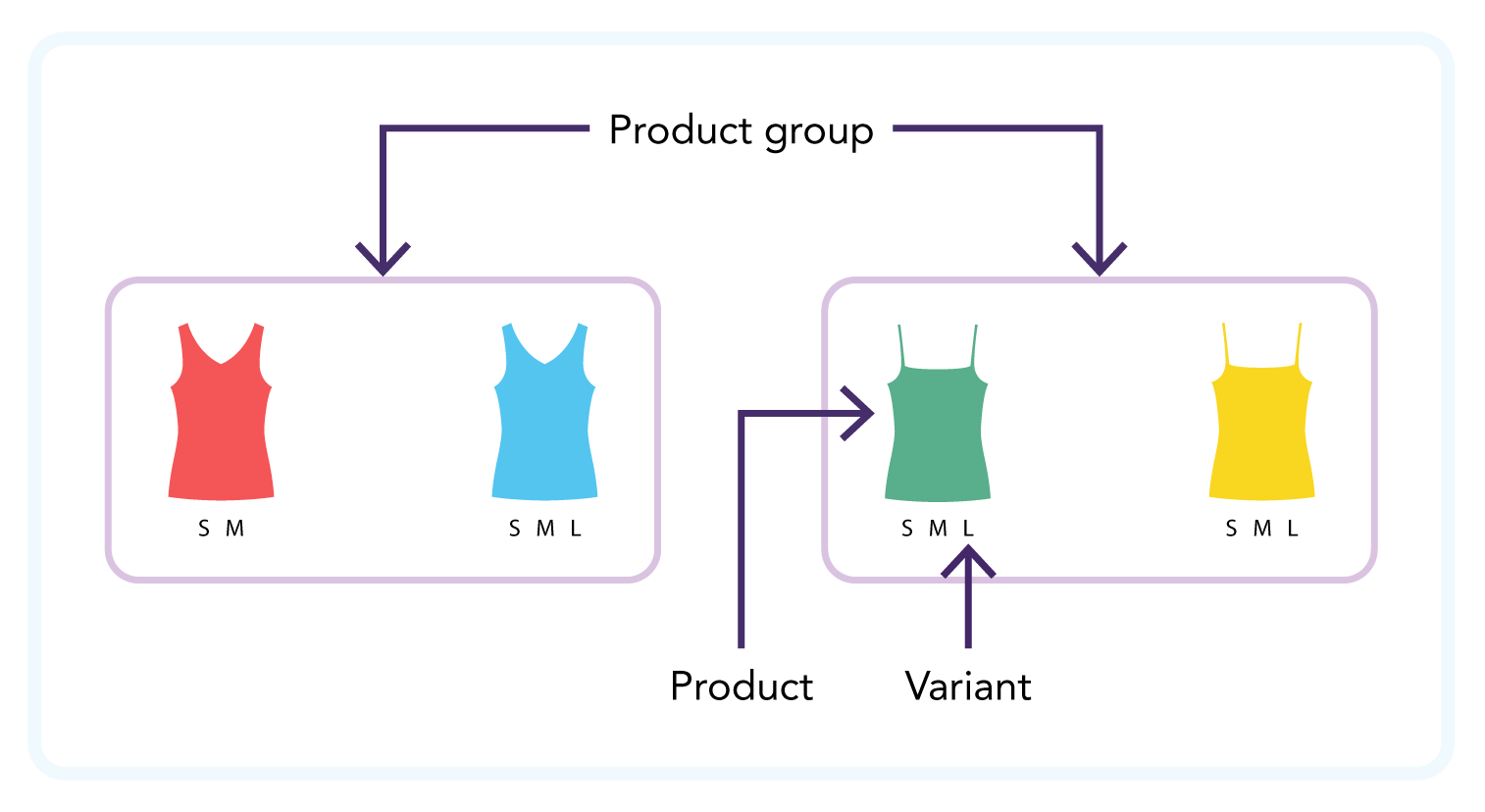
Images
Images exist on the product level. Each image object defines a single image which may have URLs with different resolutions of the same image. Multiple resolutions are used for saving bandwidth and are especially useful for thumbnails. The following image file formats are supported: webp, png, jpg, and bmp.Additional information about images
Additional information about images
An image element must have at least one URL and URLs must be unique within a product. If relative image resolutions are known, the image URLs should be ordered by ascending width, that is smallest first, otherwise it can lead to inconsistencies before it is analyzed automatically. There can be a maximum of 25 images on a product.Image URLs that are of width 100 pixels or less are considered thumbnails and will be returned in the
thumbnail field in the storefront API responses and not in the images array.Additional attributes regarding image tags, widths, and types can be set in the import. These attributes are mainly for use before the automatic image analysis is complete. There is also support for custom image attributes and the alt and caption attributes.